Saturday, 12 November 2016

Leonard Cohen

Image copyright


Leonard CohenImage  CAMPARDO
Leonard Cohen was called "the high priest of pathos" and the "godfather of 
But the influence and appeal of this poet, novelist, songwriter and legendary ladies' man has endured throughout his career.
Often prone to depression, his witty, charming and self-deprecating manner - not to mention his black humour - was reflected in his lyrics.
And after a period of retreat in the 1990s he remerged with his creativity undimmed.
Leonard Norman Cohen was born in Westmount, a well-to-do area of Montreal, on 21 September 1934.
His mother had emigrated from Lithuania to Canada and his father Nathan, whose ancestors came from Poland, owned a prosperous clothing store.
His father died when Cohen was just nine years old but left his son a trust fund that would enable him to pursue his chosen literary career.
The young Cohen attended a privately run Jewish co-educational day school where he learned to play guitar and formed a folk group called the Buckskin Boys. "Guitars impress girls", was the reasoning he gave.
Leonard Cohen on Hydra in 1960Image copyright
The Greek island of Hydra inspired his first novel
In 1951 he enrolled at Montreal's McGill University to study English Literature, and published his first collection of poetry, Let Us Compare Mythologies, in 1956.
His poetry was well-received and after a year at Columbia University in New York he turned to writing full-time producing his second collection of poems, entitled The Spice Box of Earth, in 1961 when he was 27.
The volume established Cohen's reputation as a serious poet and became his most popular work. The poem, You Have the Lovers, captured his fascination with human relationships.
He used the royalties from the book, along with literary grants from the Canadian government, to travel around the world, sampling what it had to offer - including some use of LSD when it was still legal.
After a spell in London, where his first purchases were an Olivetti typewriter and a blue raincoat, he moved to the small Greek island of Hydra, publishing his first novel The Favourite Game in 1963.
He lived there with Norwegian Marianne Jensen, for whom he later wrote So Long Marianne. Her death in early 2016 inspired Cohen's final album, You Want It Darker, released just three weeks ago.

'Cult classic'

Beautiful Losers, Cohen's second novel, was published in 1966, and was the last of his writing before he quit Hydra to move to the United States.
It prompted the Boston Globe to declare: "James Joyce is not dead. He is living in Montreal under the name of Cohen."
But the writer had already decided to move to New York and pursue a career as a songwriter and musician.
His debut album, Songs of Leonard Cohen, was released in December 1967. With its funereal tone, and Cohen's weary intonation, it was by no means a commercial success but it turned into something of a cult classic for folk buffs, and artists rushed to cover songs like Suzanne.
Among them was Judy Collins, who turned the song - based on Cohen's poem Suzanne Takes You Down - into a hit.
Over the next seven years he recorded three more albums: Songs From a Room, Songs of Love and Hate and New Skin for the Old Ceremony, which featured Chelsea Hotel - an account of Cohen's sexual encounter with singer Janis Joplin.
Leonard Cohen performing at the Isle of Wight Festival 1970Image 
Image captionHe wowed the crowd on the Isle of Wight in 1970
Despite a paralysing fear of playing live, he toured these albums extensively around the world. Those concerts included a remarkable appearance at a highly-charged Isle of Wight Festival in 1970.
The crowd was volatile and Cohen was following an electrifying performance by Jimi Hendrix, but the quiet folk singer won them over by telling a hushed anecdote about childhood trips to the circus.
"There was one thing at the circus that happened that I always used to wait for," he told the audience of 600,000.
"I don't want to impose on you, this isn't like a sing-along… but there was one moment when a man would stand up and say, 'Would everybody light a match so we can locate one another?'
"Could I ask you, each person, to light a match, so that I could see where you all are? Could each of you light a match, so that you'll sparkle like fireflies, each at your different heights? I would love to see those matches flare."
The intimate anecdote, and Cohen's subsequent performance are remembered as one of the defining moments of the whole festival.

'Perfect and broken'

In 1973, Cohen went to Israel to volunteer for active service in the Yom Kippur war. Instead he was assigned to entertain troops in a tank division where he once found himself coming under fire in the Sinai desert.
The recording of his fifth album, Death of a Ladies' Man, descended into near farce. Cohen clashed with the unstable producer, Phil Spector, whose "wall of sound" technique was at odds with Cohen's quiet acoustic based music. The resulting album was not a success, and he later disowned it.
Cohen's music fell out of favour in the late 1970s and early 1980s, but interest revived in 1985 with the release of the album Various Positions. This featured the track Hallelujah, which had taken the musician five years to write.
A mournful ballad, it touches on themes of love, sex, religion, longing and regret. Cohen said it explained "that many kinds of hallelujahs do exist, and all the perfect and broken hallelujahs have equal value".
Hated by his record company, it later became the most-covered Cohen song of all time. Jeff Buckley's haunting, melodic version in 1994 became the standard interpretation - but it only received mainstream recognition when Rufus Wainwright sang it for the animated film Shrek in 2001.
Various Positions was modestly successful, but the singer seemed confined to a small, committed audience until his backing singer Jennifer Warnes released Famous Blue Raincoat, an album of material authored by Cohen, in 1987.
It sold extremely well and introduced Cohen to a new generation of listeners. When the pair collaborated on 1988's eminently accessible album I'm Your Man, the result was his biggest album in a decade.
The record paired cynical commentaries such as First We take Manhattan, with beautiful songs of love like the title track and Take This Waltz.
In 1991 a tribute album, I'm Your Fan, a collection of his songs covered by artistes such as REM, The Pixies and John Cale, again pushed Leonard Cohen back into the limelight.
However, by this time, Cohen had begun spending time at a Buddhist retreat in California and eventually moved there to become a Buddhist monk in 1996.
He finally emerged in 1999 with a wealth of new material, some of which featured on his 2001 album, aptly titled Ten New Songs.
Leonard Cohen at Glastonbury 2008
Image captionGlastonbury was the highlight of his 2008 tour
Co-written with the producer and vocalist, Sharon Robinson, who also played all the instruments, it saw Cohen in introspective and relaxed mood, but perhaps contemplating mortality with lyrics such as, "the night is getting colder".
In 2006 Cohen, at the age of 73, was obliged to return to touring when he discovered that his manager (and former lover) Kelley Lynch had embezzled more than $5m from his account.
Despite winning a court case against her, and being awarded huge damages, she failed to pay back any of the money. Lynch would later be jailed after violating a court order to keep away from Cohen.
Two years later, he embarked on a marathon concert tour in 2008 which ran for 18 months and included a performance on the Pyramid stage at Glastonbury - which was seen by many as the highlight of the festival.
2012 saw the release of Old Ideas, which became his highest charting album of all time. Many critics saw the songs on the album as an intimation of his own mortality. However, despite his advancing years, Cohen set off on a world tour to promote the album.
When the Grand Tour ended in December 2013, Cohen largely vanished from the public eye - but he continued to write.

'Swansong'

Just last month, he released You Want It Darker, produced by his son Adam. Severe back issues made it difficult for Cohen to leave his home, so Adam placed a microphone on his dining room table and recorded him on a laptop.
Like David Bowie's Blackstar, the record felt like a swansong. "I'm leaving the table / I'm out of the game," he lamented on Leaving The Table.
The album received positive reviews, but a New Yorker interview tied to the release revealed Cohen making peace with mortality.
"I am ready to die," he said. "I hope it's not too uncomfortable. That's about it for me."
Cohen was, arguably, one of the most enigmatic poets and songwriters of his generation. While many of the themes in his work hinted at depression, he always felt that he was just a keen observer of the realities of life.
"Seriousness, rather than depression is, I think, the characteristic of my work," he once told an interviewer.
"I like a good laugh, but I think there's enjoyment that comes through seriousness. We all know when we close the door and come into your room and you're left with your heart and your emotions, it isn't all that funny."

Jimmy Young

Jimmy Young
For more than six decades, Jimmy Young was a key figure in British broadcasting.
The one-time crooner, who had a string of hit singles in the 1950s, went on to become one of radio's best loved presenters.
During his career, a veritable who's who of royalty, politicians and celebrities subjected themselves to his gentle yet probing style of interview.
His acrimonious departure from the BBC in 2002 led to a storm of protest, including questions in parliament.
He was born Leslie Ronald Young in Cinderford, Gloucestershire on 21 September 1921.
He was keen on music from an early age and learned to play the piano as well as having professional voice training.
Image 
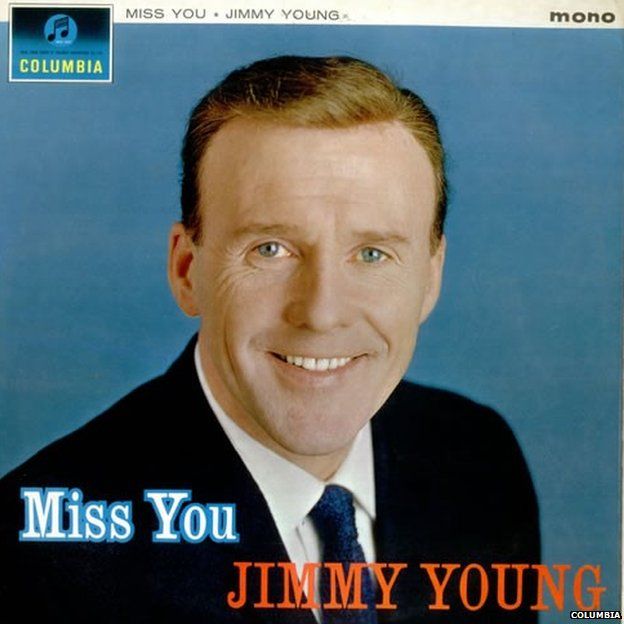
Image captionMiss You was one of many Top 20 hits
His parents divorced in 1939 and Young moved to South Wales. He signed up with the RAF on the outbreak of war after falsely giving his age as 18. He was, in fact, three weeks short of his 18th birthday.
Shortly after he was demobbed in 1949, he was spotted singing in a club by a BBC producer and went on to make a number of broadcast appearances as well as touring across the UK.
His first release, a cover of the Nat King Cole song, Too Young, was a huge hit just a year before the UK Singles Chart was born.
He signed to Decca in 1952 and enjoyed a number of Top 10 hits. He was also asked to perform some of the songs in Gene Kelly's film, Invitation to the Dance.

Easy listening

But, by the end of the 1950s rock and roll was the new craze and crooners like Young suddenly found themselves out of fashion.
His income plummeted, he sank into depression and turned to drink to ease the pain. He later confessed that he had contemplated suicide.
In desperation he visited a fortune teller who informed him he was going to be a great success. He picked himself up and went back into radio.
Jimmy Young record coverAfter hosting a show called A Young Man's Fancy on Radio Luxembourg he moved to the BBC Light Programme.
Jimmy Young & Gene KellyImage copyright
Image captionThe young crooner with Gene Kelly in 1952
He became one of the hosts of Housewives' Choice, playing easy listening music while outside in the real world the Beatles and Rolling Stones fought for chart supremacy.
Five years after the Beatles' first hit single the BBC finally launched Radio 1, a station devoted to pop music, to fill the gap left by the closure of the pirate radio stations.
While many of the new station's young DJs were ex-pirate presenters, Young, by then 46, became part of the line-up.
A lack of money meant some output was broadcast across both Radio 1 and Radio 2, as the old Light Programme was now called, and Young presented the mid-morning show.

Experts

In contrast to the brash style of the Breakfast Show, presented by Tony Blackburn, Young's programme was much more sedate in tone.
It included regular consumer information, recipes and discussions on current affairs.
In 1973, the BBC revamped its music stations and Young's show was heard solely on Radio 2.
Radio 1 DJs 1967
Image captionRadio 1 DJ line-up from 1967 with Young 2nd from left in back row
Over the next 30 years, the format remained much the same with experts, such as Tony di Angeli from the Grocer magazine and "Legal Beagle" Bill Thomas dealing with listeners' queries.
His shows were peppered with catchphrases such as "BFN" and "Orf we jolly well go", as well as the squeaky voice of Raymondo with his, "What's the recipe today Jim?"
During his tenure he interviewed every prime minister as well as members of royalty and other celebrities.
Margaret Thatcher appeared on the show 14 times and declared Young was her favourite presenter.

Ousted

His interviewing style was probing but gentle, something the Labour politician Roy Hattersley described as "courtesy with a cutting edge".
His detractors claimed he was too soft with politicians, something that Young always strongly denied.
"You catch more flies with honey than vinegar," he once said. "I hold conversations. I am a listener."
John Major & Jimmy Young
Image captionMany senior politicians appeared on the programme
By the turn of the century, Young was in his 80s and BBC management was desperate to attract a younger audience to Radio 2.
The new controller, Jim Moir had already ousted Ed Stewart and John Dunn and he now turned his attention to the Jimmy Young programme.
When news that he was to be replaced leaked out, Young, who by now had collected a knighthood, hit back with a well-organised PR campaign.
He gained huge support from listeners and a diverse range of well-known figures. An Early Day motion was put down in Parliament calling on the BBC to keep him on.

Ire

Young himself was not going quietly. Saying that he was flattered that so many people wanted his job he went on to make clear he had no plans to leave.
"Unless, of course, in the ageist pursuit of youth someone decides to ignore my record-breaking ratings and fire me."
Eventually after much bitter wrangling it was announced that Young would be relinquishing his morning show to Jeremy Vine.
Jimmy Young
Image captionHis final lunchtime show
"Just so that we're all singing from the same hymn book, it was not my idea to go - I didn't want to leave you at all and I know from your messages that you don't want me to go either."
Young was asked to present a weekly show on Sundays but he turned the offer down venting his ire at the BBC's decision in a newspaper article.
The hatchet was eventually buried and in 2011, Young was back behind a microphone in a special programme to mark his 90th birthday.
While Radio 2 went through many changes during Young's tenure, his show remained much as it had begun and one of the station's flagship programmes.
Jeremy Vine, the man who took over Jimmy Young's show, once summed up his appeal.
"Jimmy was just a totally ordinary, honest bloke, the least pretentious person you could ever imagine. And his audience adored him for it."

Wednesday, 2 November 2016

Dave Lanning, darts and speedway commentator

Dave Lanning
Dave Lanning
Dave Lanning, who has died aged 78, was almost as synonymous with darts as his co-commentator Sid Waddell; their humorous style of broadcasting did much to shape the sport’s image and to make it a success when it began to be televised in the 1970s.
Although Waddell was the better-known figure, in part because of his distinctive Geordie accent and penchant for hyperbole, he admitted frankly that Lanning was his inspiration. The pair met in 1972 when Waddell, then a documentary maker with Yorkshire Television, went to watch the transmission of the final of the News of the World darts championship from Alexandra Palace.
It was the first time that the sport had been shown on television. Waddell appreciated at once that the patter and puns with which the meticulously prepared Lanning larded his commentary skilfully concealed the essentially repetitive nature of the action. 
Waddell, whose background was working-class although he had gone to Cambridge, was fascinated by the sub-culture that darts embodied.
When it then became one of the pub games shown in Yorkshire’s series The Indoor League (presented by former England cricketer Fred Trueman), Lanning suggested that Waddell had the makings of a commentator and they quickly established a reputation for trading witticisms.
Sid Woodell (left) and Dave Lanning (right) with Stephen Fry in the commentary box
Sid Waddell (left) and Dave Lanning (right) with Stephen Fry in the commentary box
“With darts commentary, it’s no good doing it straight – 180, 24, 140,” observed Waddell later. “You need a bit of frisson and Dave Lanning is the master of the instant rapport. If I say 'parity’, he says 'sick as a parity’. It’s like Morecambe and Wise.”
One instance of Lanning’s ability was his definition of the differing playing styles of Phil “The Power” Taylor, latterly the game’s dominant player, and his erstwhile mentor, the “Crafty Cockney” Eric Bristow. “Taylor is a mugger,” said Lanning, “Bristow is a burglar.” 
It was Lanning who dubbed Waddell “The Thief of Bad Gags”.
While Waddell moved to the BBC, Lanning commentated on tournaments for ITV’s World of Sports between 1972 and 1988, drawing three million viewers. With characteristic coolness, he called the first televised nine-dart finish, accomplished by John Lowe in 1984.
Lowe needed double 18 to check out and though another dart blocked the camera’s view of the bed, Lanning correctly judged the throw from Lowe’s reaction. “John Lowe wins £100,000”, he said, his sang-froid all the more impressive as the feat won Lanning £12,000 in a side bet of his own.

A portrait of commentators: (L-R) Sid Waddell, Stuart Pyke, Dave Lanning and John Gwynne
A portrait of commentators: (L-R) Sid Waddell, Stuart Pyke, Dave Lanning and John Gwynne  
He and Waddell (who died in 2012) were reunited in 1994 when Sky began to transmit darts and in 2005 were inducted together into the PDC Hall of Fame. 
Even so, after he retired in 2011, Lanning admitted that he thought his commentator’s style had never really suited Sky because “I found it difficult to scream loudly enough.”
David Lanning was born on March 24 1938 and educated at Poole Grammar School. He attended his first speedway meeting at 10 and after a stint on the Bournemouth Echo became in 1965 the press officer for the West Ham speedway team. 
Later he managed them as well as promoting speedway at Eastbourne and Reading. He also did stadium commentaries, savouring the time he told the rider Barry Briggs to hasten as he had “Two Aussies up his pipe.”
He wrote on speedway for The Sun for 20 years and commentated on 50 successive speedway world finals. He had a long association with the TV Times, was television critic of The Sunday People, and wrote several books about darts and speedway. These included a novel, Cinderfellas.
He is survived by his wife of 57 years, Leona, and by two sons and a daughter.
Dave Lanning, born March 24 1938, died October 29 2016

Carlos Alberto, Brazilian footballer and sublime goal-scorer

Carlos Alberto
Carlos Alberto
Carlos Alberto, who has died of a heart attack aged 72, captained Brazil to victory in the 1970 World Cup, scoring the most sublime goal in the history of “the beautiful game” when the greatest team to have graced the tournament won the trophy outright.
The seeds of Brazil’s triumph were sown in England in 1966 when the side were outmuscled by European opposition despite their technical superiority. Carlos Alberto, who had made his international debut two years before in a 5-1 drubbing of England at the Maracana, had been unexpectedly omitted from the squad.
The experience toughened him still further and he became such a commanding presence in the dressing room that the new manager, Mário Zagallo, made him captain at 22. Aware that the next tournament would be played at altitude in Mexico, the Brazilians worked hard at their fitness in the months before.
Alberto playing for Santos during the 1972/1973 season
Alberto playing for Santos during the 1972/1973 season 
Moreover, perhaps for the first time they began to play as a unit. With the side based around players from Santos – Carlos Alberto and Pelé’s club – they won all their qualifying fixtures. They then advanced in similar style to the World Cup final against Italy, having beaten holders England at the group stage in the match remembered for Gordon Banks’s save.
Italy had defeated West Germany 4-3 in extra time in the semi-final, but were simply dismantled by the sorcerers in gold and green. Leading 3-1, Brazil capped their performance with an unforgettable goal. On the edge of the penalty area, Pelé rounded off the eight-man move with a blind pass for the overlapping Carlos Alberto, galloping up from right back, to score with a fulminating shot.
A few minutes later, the captain was raising aloft the Jules Rimet trophy. It was Brazil’s third triumph in the competition, one which allowed them to keep the cup and brought legendary status to “o capitão” in his homeland. On his death, the Brazilian football federation declared three days of public mourning.
Alberto collecting the World Cup trophy in Mexico
Alberto collecting the World Cup trophy in Mexico 
Carlos Alberto Torres was born in Rio de Janeiro on July 17 1944. His father worked as a mechanic and, too poor to afford a football, young Carlinhos learned the game on the streets using old socks stuffed with newspaper. An older brother was already on the books of Fluminense, one of Rio’s main clubs, and Carlos Alberto followed him there at 16. Their father wanted them to become doctors and strongly opposed their choosing a career which then paid little and in Brazil was associated with the slums.
But while his brother opted for work in a bank, Carlos Alberto’s talent was such that at 18 he was chosen for the Olympic team which went on to win gold in Tokyo. The following season he made his debut at full-back for Fluminense. The team claimed the regional championship that year – Brazil was so large that it then had no national league – and Carlos Alberto was hailed for both his marauding attacks and aggressive tackling.
Franz Beckenbauer (left) and Carlos Alberto (right) at Pele's farewell game in 1977
Franz Beckenbauer (left) and Carlos Alberto (right) at Pele's farewell game in 1977 
In 1966 he moved teams to Santos, playing alongside Pelé, Gilmar and Coutinho. The side won the Sao Paulo championship four times in the next six years. Carlos Alberto made 445 appearances for the club, scoring 40 goals, before returning to Fluminense in 1974. Although he won two more titles there, he missed that year’s World Cup with a knee injury.
This led to a loss of pace, and when he was recalled to international football in 1977 it was at centre-back. Though he acquitted himself well in qualifying for the World Cup, he decided to retire from the national side after 53 caps and moved to New York to play for the Cosmos. There he was reunited with Pelé, became great friends with Franz Beckenbauer, and won three NASL titles as well as being voted the league’s best player.
After hanging up his boots in 1983, he became a manager, although like many of his contemporaries he never matched his achievements on the pitch. Of the dozen clubs of which he took charge over the next two decades, he enjoyed most success with Flamengo. With Zico inspiring them, they became national champions in 1983. The next season, Carlos Alberto won the Rio regional title with Fluminense.
Carlos Alberto as manager of Azerbaijan at the World Cup qualifier in 2006
Carlos Alberto as manager of Azerbaijan at the World Cup qualifier in 2006  
Later he coached Oman and Azerbaijan. In 2005, soon after the latter had lost to Sven Eriksson’s England at St James’s Park, he resigned following defeat by Poland, having attacked a referee and made claims that the match was fixed.
He became a commentator in Brazil and latterly bemoaned the sterility of the national team’s play and urged young players to sleep with a ball as a pillow as proof of their dedication.
From 1989 until 1993, he was a local councillor in Rio and in 2008 a candidate for deputy mayor. In 1998, he had been one of three Brazilians named in Fifa’s team of the century, the others being Nilton Santos and Pelé.
He was married three times and is survived by his widow Graça and two sons of his first marriage.
Carlos Alberto, born July 17 1944, died October 25 2016