Showing posts with label pop star obituaries. Show all posts

Wednesday, 28 March 2018

Glen Campbell

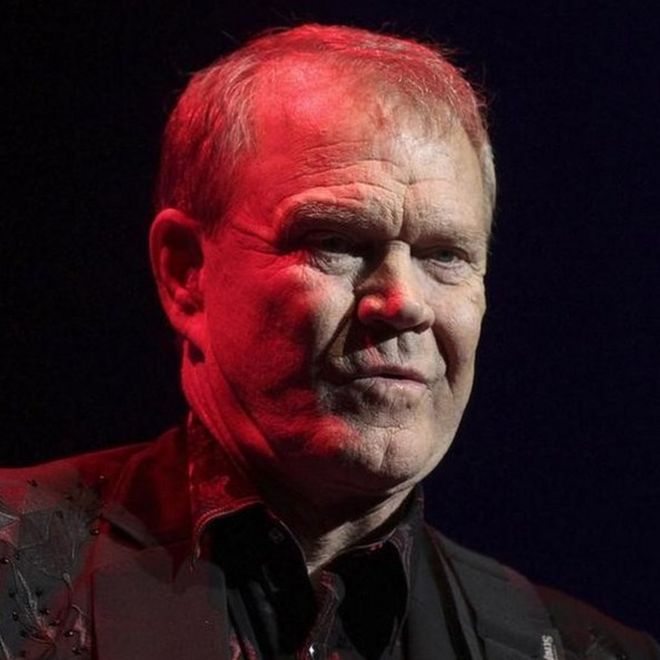
Glen CampbellImage copyrightREUTERS
Glen Campbell was one of the most successful country singers of his generation.
In a career spanning six decades, he released more than 70 albums and amassed nine Grammy awards.
His melodic songs found success in the pop charts with hits including Galveston, Rhinestone Cowboy and Wichita Lineman.
And he also made a foray into acting, notably alongside John Wayne in the film True Grit.
Glen Travis Campbell was born in Pike County, Arkansas, on 22 April 1936, the seventh of 12 children.
His father was a sharecropper, a tenant who paid his rent with a proportion of the crops that he grew.
His first guitar cost $7 from a Sears catalogue and he whiled away the time teaching himself to play.
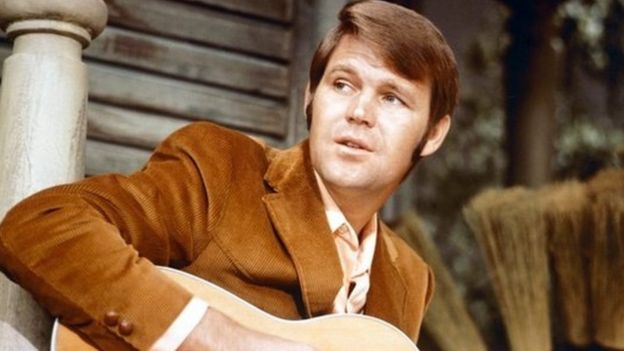
Glen Campbell in 1967Image copyrightGETTY IMAGES
Image captionBy the mid 1960s he'd established himself as a solo artist
"We didn't have power in the house, but we did have an old battery radio. And whenever I heard a new song, usually on a local country station, I'd learn it."
His proficiency led to an offer to join a band fronted by his uncle, Dick Bills and the Sandia Mountain Boys. There were appearances on local radio and a spot on a children's TV channel.
Campbell moved to Los Angeles in 1960 and became a member of a group of musicians named The Wrecking Crew, who backed artists such as Dean Martin, Nat King Cole and Frank Sinatra.
His first solo chart entry, Turn Round and Look at Me, reached 62 in the Billboard Hot 100 in 1961.

Fruitful partnership

He also played a pivotal role in the producer Phil Spector's famous Wall of Sound technique.
"When I met Phil, he was knocked out by my playing," Campbell later recalled. "He was like a child with a new toy."
For three months in 1965 he toured with the Beach Boys, filling in for singer Brian Wilson, who had experienced a breakdown.
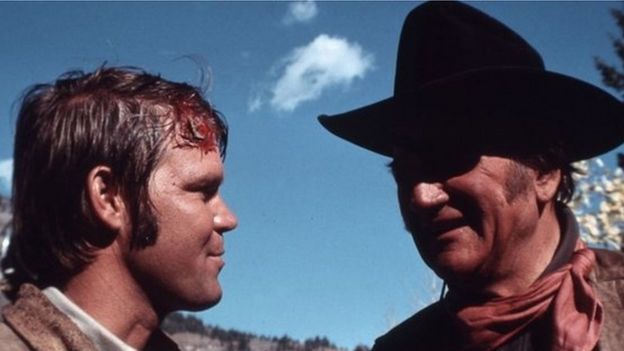
Glen Campbell & John Wayne in True GritImage copyrightRONALD GRANT
Image captionJohn Wayne invited him to star in True Grit
His big break came in 1967 with the Jimmy Webb song By the Time I Get to Phoenix, which reached number two in the US Country charts.
Campbell's partnership with Webb was to be a fruitful one, as hit followed hit. Wichita Lineman went to No 1 in the US and also broke him in Britain where it reached the Top 10 in 1968.
"Jimmy used to write in the studio as I was recording," said Campbell. "When he sang me the parts of Wichita Lineman he'd written, I knew it was a hit."
The song collected a Grammy and became much requested by US soldiers fighting in Vietnam.

Primetime show

He followed it up with Galveston a year later, which again charted on both sides of the Atlantic.
In January 1969 he started hosting his own primetime TV show, The Glen Campbell Goodtime Hour.
The show, which ran for three years, made him a huge star and his fame encouraged a glittering roster of stars to appear with him.
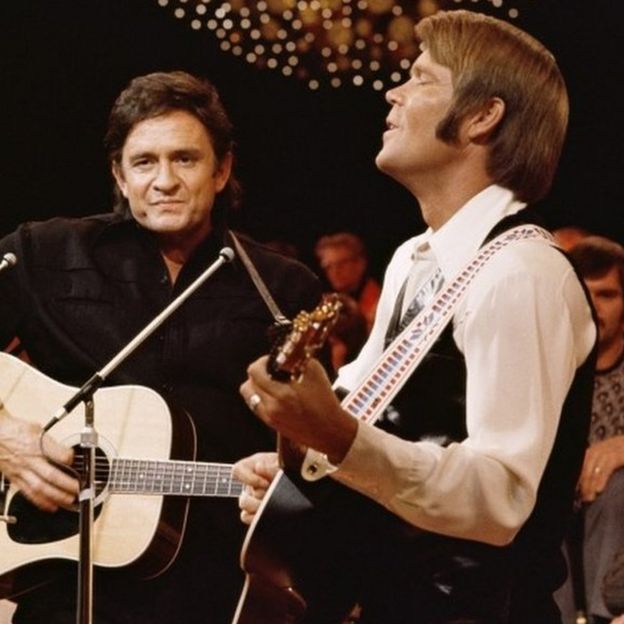
Johnny Cash and Glen CampbellImage copyrightGETTY IMAGES
Image captionHis primetime TV show attracted stars like Johnny Cash
Johnny Cash, Roger Miller, Willie Nelson and the Monkees were among the artists who were guests on the show.
He was also invited by John Wayne, a long time Campbell admirer, to appear in the Western True Grit. He won a Grammy for his performance of the film's title song.
His biggest hit came in 1975 with Rhinestone Cowboy, which reached the Top 10 in a number of countries, including the UK. It coincided with a series of shows on BBC television
There was another smash in 1977, - Southern Nights - but both his career and personal life began to slide. He divorced his second wife in 1975 but a subsequent marriage lasted just four years.

Salvation

While country aficionados continued to buy his records, his mainstream audience had begun to desert him.
He turned to alcohol and drugs for solace. "I was fine when I was doing session work. My schedule then would have killed a horse, so there was no time for drugs," he later said.
"But later on, I didn't have any stability. After a couple of failed marriages, it became a bit of a habit."
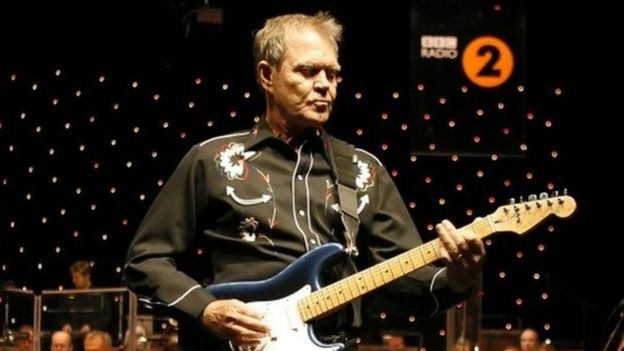
Glen Campbell
Image captionHe had a huge fanbase in the UK
His short but high profile relationship with 21-year-old country star Tanya Tucker, 25 years his junior, provided much fodder for the gossip magazines.
His salvation came when he met and married Kim Woolen in 1982 and turned to God.
"I got down on my knees and prayed. And, eventually, I got rid of those demons." Apart from a brief lapse in 2003, when he was jailed for drink-driving, he stayed off the booze and the drugs.
In 2005 he was inducted into the Country Music Hall of Fame. Throughout this period, he continued to play and record and released covers of songs by artists as diverse as U2 and Green Day.
In 2011 Campbell announced he had been diagnosed with Alzheimer's disease and set off on a farewell tour that included an emotional goodbye at the Grammy Awards in February 2012.
"I've accomplished everything I wanted to do," he said in a 2012 interview. "I've been blessed. When I think back to where I came from, I have been able to do some amazing things in my life. And music will always be part of my life."

Sunday, 19 March 2017

Chuck Berry


Chuck Berry's trademark four-bar guitar introduction and quickfire lyrics reflected the rebelliousness of the youth of the 1950s.
He was one of that exclusive group who took rhythm and blues from its black roots and "crossed over" to make it part of most teenagers' lifestyle.
He influenced generations of succeeding rock stars, most notably the Beatles, the Rolling Stones and the Beach Boys.
Yet he faced major financial difficulties through mismanagement and had frequent brushes with the law.
Charles Edward Anderson Berry was born into a middle-class family in St Louis, Missouri, on 18 October 1926.
As a teenager he began playing concerts in his local high school but his education was curtailed after he was convicted of armed robbery and spent three years in a reformatory for young offenders.
Chuck Berry performing in the 1960sImage copyright
Image captionHe had one of the first rock and roll hits
On his release he made a living as a hairdresser, playing in a trio in the evenings with Ebby Harding on drums and Johnnie Johnson on piano. Johnson would remain with Berry throughout his career
He was influenced by blues heroes such as Muddy Waters and T-Bone Walker, as well as white country and western music, though his singing style owed much to the clarity of Nat King Cole.
"My music is simple stuff," he once said.
"Anyone can sit down, look at a set of symbols and produce sounds the music represents."

Charged

His recording career began in 1955 with the legendary Chess label in Chicago, where his first release Maybellene became one of rock and roll's first hits.
In the next few years, he scored a succession of hits, all aimed at an adolescent audience, including Roll Over Beethoven, Sweet Little Sixteen, Carol and the classic Johnny B. Goode.
His music transcended the colour bar that plagued many contemporary black artists as affluent white teenagers in Eisenhower's America reached out for something new.
"I play the songs they want to hear," he said.
"That makes them feel they're getting what they came for."
Chuck Berry doing the duck walkImage copyright
Image captionThe so-called duck walk became a trademark
He appeared in several rock films including Rock, Rock, Rock and Mr Rock and Roll, both from 1957; Go Johnny Go from 1959; and Jazz on a Summer's Day in 1960.
In 1962 he was charged with transporting a minor across state lines for immoral purposes.
The girl in question was a 14-year-old from Texas who he claimed he had brought to Missouri to check hats at his St Louis nightclub.
After he fired her, she complained to the police. In court, the judge's summing-up was blatantly racist and the trial was eventually declared null and void.

Double entendres

His conviction at a second trial and the resulting two-year sentence left him embittered.
His release coincided with the rhythm and blues revival in Britain. With his material being covered by bands like The Beatles and the Rolling Stones, his work was discovered by a new generation.
"If you tried to give rock and roll another name," John Lennon famously said, "you might call it Chuck Berry."
Chuck Berry plays at a 60th birthday tributeImage copyright
Image captionOn stage with Keith Richards at a 60th birthday tribute
Successful tours followed. He scored a few more hits with No Particular Place to Go and Memphis, Tennessee. His biggest hit came later in Britain with the atypical 1972 novelty record, My Ding-a-Ling, replete with double entendres.
When he wasn't churning out the hits, Chuck Berry was thrilling audiences with his live performances. His trademark became his duck walk, a crouching movement across the stage made during his guitar solos.
Offstage, he could be a prickly character, exemplified in the 1987 film Hail! Hail! Rock 'n' Roll which featured a tour with a backing band organised by devotee Keith Richards of the Rolling Stones.
In the same year, he published an explicit autobiography genuinely penned by himself.

Jail sentence

Berry's attitude to money was notorious. He demanded cash upfront for many of his concerts and in 1979, he served a 100-day jail term for tax evasion.
There were further brushes with the law. In 1988 he settled a lawsuit from a woman he allegedly punched in the face.
Two years later he was sued by a group of women after it was discovered that a hidden camera had been placed in the toilets of his restaurant in Missouri.
Chuck Berry playing in Chile in 2013Image copyright
Image captionStill on the road at the age of 87
He also received a suspended jail sentence for marijuana possession.
Despite the advancing years, he continued playing one-night concerts and embarked on a European tour in 2008 at the age of 82.
In January 1986, Berry was among the first musicians to be inducted into the Rock and Roll Hall of Fame with a citation that summed up his contribution to popular music.
"While no individual can be said to have invented rock and roll, Chuck Berry comes the closest of any single figure to being the one who put all the essential pieces together."
Berry himself had a simple explanation for his success.
"It amazes me when I hear people say, 'I want to go out and find out who I am.' I always knew who I was. I was going to be famous if it killed me."

Sunday, 25 December 2016

Rick Parfitt


Rick Parfitt

With his flowing blond locks, denim gear and Fender Telecaster, Rick Parfitt was one of rock's most recognisable guitarists.
His partnership with Francis Rossi became the core of Status Quo, one of Britain's most enduring bands.
Their brand of boogie-woogie rock survived changes in musical fashion and made them one of the best-loved live acts of their generation.
As well as driving the Quo sound on stage, Parfitt penned many of the band's biggest hits.
Richard John Parfitt was born in Woking, Surrey, on 12 October 1948.
He began playing a guitar when he was 11 and, on leaving school at 15, got a job performing at Sunshine Holiday Camp in Hayling Island, Hampshire, earning £5 a week.

Rick Parfitt and Status Quo in 1968Image copyright
Image captionThe band's early incarnation embraced the psychedelic movement

However, much of his new income went to his father, who was a committed drinker and gambler.
"He was forever getting in trouble and coming to me crying," Parfitt later recalled. "I probably ended up giving him a couple of thousand quid in total. Back then, that was a lot of money."
Parfitt met Francis Rossi in 1965 when they were both playing with their respective bands at a Butlin's holiday camp in Minehead.

Disillusioned

Two years later Parfitt, along with Rossi, Alan Lancaster, John Coghlan and Roy Lynes came together to form Status Quo.
The band's first hit, Pictures of Matchstick Men, released in 1968, embraced the psychedelic movement of the time and went to number seven in the UK charts.
Their follow-up, Black Veils of Melancholy, failed to chart but they did get to number eight with Ice in the Sun, written by Marty Wilde.

Status QuoImage copyright
Image captionRick Parfitt and Francis Rossi remained the core of Status Quo

But the band were becoming disillusioned with the direction they were taking. They abandoned their flowery clothes, embraced denim and T-shirts and settled down to a more traditional style of rock.
Parfitt co-wrote two of the tracks on their breakthrough album, Piledriver, released on the Vertigo label in 1972.
In an interview in 2014, Parfitt said of the record. "You know what? I love every track on that album! I think All The Reasons is just such a beautiful song. I wrote that about my wife at the time."

Live Aid

The album became the template for subsequent releases, with Parfitt receiving a number of writing credits.
Whatever You Want, co-written by Parfitt and Andy Bown, became one of the band's biggest hits and a staple of their increasingly popular live shows.
Outside the Quo tent the musical landscape was changing, from prog to punk, and into the '80s with the New Romantics.

Rick Parfitt (left) and Status Quo in 1984Image copyright
Image captionParfitt (left) and the Quo ignored the changes in musical and sartorial fashion

Inside the tent, the band continued to play their 12-bar blues style maintaining an ever loyal fan base.
The band set off on a farewell tour in 1984 but decided to carry on after Bob Geldof persuaded them to open the Live Aid concert the following year.
"God, I'm so pleased we did it now. Quo opening Live Aid, it was meant to be."

'Selfish child'

They also embraced the hedonistic rock lifestyle with gusto. Parfitt admitted spending £1,000 a week on cocaine and another £500 on vodka.
His addictions, coupled with the tragic drowning of their two-year-old daughter, Heidi, led to the breakdown of his first marriage to Marietta Broker.
"It's not buying the drugs that is the most expensive thing," he later said. "It's the divorce which taking drugs eventually leads to."
He later married Patty Beedon, who had been his childhood sweetheart. The couple divorced and reunited again, before finally going their separate ways.

Rick Parfitt and his third wife LindsayImage copyright
Image captionParfitt finally settled down with his third wife Lindsay

It was an acrimonious separation, with Patty later describing him as "a selfish child who never grew up".
Parfitt's experience of paying millions in divorce settlements made him vow never to marry again, but he tied the knot again in 2006 with Lyndsay Whitburn, a fitness instructor.

Relaxed life

In 2010, Parfitt and Rossi were awarded the OBE for services to music, posing together with their gongs after the investiture ceremony.
By this time Parfitt had suffered a number of health problems including undergoing quadruple heart bypass surgery in 1997. He made a full recovery and was performing with the band within a matter of months.
Doctors warned the musician that he would have to leave behind his rock lifestyle, although he admitted at the time that he still enjoyed "the odd pint".
By 2014 he was living a relaxed life in Spain.
"I haven't smoked a joint for 27 years and I haven't done any cocaine for 10 years. I just do normal stuff - the kids keep me busy and I go shopping with the missus."
Other band members came and went over the years but Parfitt remained, with Rossi, the definitive face of Status Quo.

Rick Parfitt and Francis RossiImage copyright
Image captionStatus Quo stalwarts: Parfitt and Rossi together at a film premiere in London in 2013

While Rossi officially remained the band's frontman, the musical partners were hard to separate on stage.
In contrast to the rows that are part of many rock bands, the two remained good friends throughout the decades.
When Status Quo had embarked on what they hinted would be their final tour, Parfitt offered an explanation for the longevity of veteran rock bands.
"Why do you think all these bands like the Stones and Deep Purple stay on the road? We're having fun and I love being up there on stage. Once the lights go down and the crowds roar, something magical happens. All your aches and pains go."
He added: "It would be weird to just stop because I would have nothing to do."

George Michael


File photo dated 28/06/86 of George Michael on stage for Wham"s last sell out concert at Wembley Stadium in LondonImage copyright
His talents as a singer, songwriter and music producer made George Michael one of the world's biggest-selling artists.
Blessed with good looks and a fine singing voice, his stage presence made him a favourite on the live concert circuit as he matured from teen idol to long term stardom.
After early success in the duo Wham! he went on to build a solo career that brought him a string of awards and made him a multi-millionaire.
But there were times when his battle with drugs and encounters with the police made lurid headlines that threatened to eclipse his musical talents.
George Michael was born Georgios Kyriacos Panayiotou in North London on 25 June 1963. His father was a Greek Cypriot restaurateur who had come to the UK in the 1950s, while his mother was an English dancer.
It was not altogether a happy childhood. Michael later recalled that his parents worked constantly to improve their financial status leaving little room for affectionate moments. "I was never praised, never held. So it wasn't exactly the Little House on the Prairie."
He moved with his family to Hertfordshire while in his teens and met Andrew Ridgeley, a fellow pupil at a local school. The two discovered they had a shared interest in music and, together with a group of friends, formed a ska band which had a short lived existence.
In 1981 Michael and Ridgeley formed Wham! Their first release, Wham Rap! failed to trouble the charts but the follow up, Young Guns (Go For It) established the group after they were asked at the last minute, to perform it on Top of the Pops complete with dancers. The record quickly rose to No 3 in the UK charts.

File photo dated 08/10/84 of WhamImage copyright
Image captionMichael (right) with Wham! bandmate Andrew Ridgeley
The duo initially adopted a leather-clad rebellious image with songs such as Bad Boys, but moved to a more pop-oriented approach with the world-wide hit, Wake Me Up Before You Go-Go, while the band members swapped their leathers for more fashionable attire.
With Michael very much the front man, it was almost inevitable that he would eventually strike out on his own. The 1984 single, Careless Whisper, while co-written by Ridgeley, was to all intents and purposes a George Michael solo effort. Indeed it was credited to Wham! featuring George Michael in the US.
Wham! finally split up in 1986 and in the spring of the following year Michael released I Knew You Were Waiting (For Me) a duet with one of his musical icons, Aretha Franklin.
He was also beginning to experience doubts about his sexuality. In an interview with The Independent he blamed his depression after the Wham! breakup on the dawning realisation that he was not bisexual but gay.

Legal battle

Michael spent most of 1987 writing and recording his first solo album, Faith, which was released in the autumn of that year. It went to the top of both the UK and US charts going on to sell more than 25 million copies and winning a Grammy in 1989.
The first single from the album, I Want Your Sex, caused some controversy, particularly on US radio stations. Many refused to play it at all while others played a version substituting the word love for sex. In any event the single reached the top three on both sides of the Atlantic.
A 1988 world tour cemented Michael's status as a pop superstar although the constant touring and the adulation of thousands of screaming teenage girls left him feeling exhausted and only exacerbated the periods of depression that he was now beginning to experience on a regular basis.
Indeed he refused to promote his second album, Listen Without Prejudice Vol. 1 and no videos were made to back up the single releases. A much more introspective work than Faith, the album was aimed at a more adult audience.

File photo dated 13/07/85 of George Michael of Wham performing at the Live Aid concert at Wembley Stadium in LondonImage copyright
Image captionMichael performing in the Live Aid concert in 1985
It failed to achieve the success of his previous work in the US although there were contrasting fortunes in the UK where it actually outsold Faith.
While playing a concert in Rio on his Cover to Cover tour in 1991 he met Anselmo Feleppa, the man who would become his partner, although Michael still did not publicly state that he was gay. Their relationship was to be short-lived as Feleppa died of a brain haemorrhage in 1993.
Plans for Listen Without Prejudice Vol 2 were scrapped amidst a legal dispute with his record company, Sony. In what proved to be a long and costly battle Michael finally severed his relationship with Sony.
In November 1994, Michael released the single, Jesus to a Child, a tribute to his dead lover, Feleppa. It went straight to No 1 in the UK. The single featured on the Older album, which had been three years in the making when it was released in 1996.

Coming out

A dark and sometimes melancholy work, Older contained a number of references to his sexuality and his change of image saw the long hair and beard replaced by a cropped haircut and leather clothes.
The album was a big success in the UK and Europe but achieved disappointing sales in the US, where audiences still seemed to hanker after Michael the pop superstar rather than the more serious artist that he had aspired to become.
He was voted Best British Male at the Brit Awards and won the title Songwriter of the Year for the third time at the Ivor Novello awards.
The death of his mother from cancer saw him spiral into another round of depression. He told GQ magazine that he had contemplated suicide and had only been dissuaded by the support of his new partner, Kenny Goss.
File photo dated 11/04/99 of Tom Jones (left) and George Michael performing a duet during a tribute concert to Sir Paul McCartneyImage copyright
Image captionMichael performing at an event in memory of Linda McCartney with Tom Jones in 1999
In April 1998 he was arrested in a Beverley Hills public toilet by an undercover police officer and charged with engaging in a lewd act. He was fined and sentenced to 80 hours of community service.
The incident finally persuaded him to go public about his sexuality and his relationship with Kenny Goss, a Dallas based businessman.
He continued to record, releasing an album of cover tracks in 1999 entitled Songs from the Last Century, before spending two years writing and recording the album, Patience, which was released in 2004.
It was seen as something of a comeback, achieving instant success in the UK and even reaching No. 12 in the US, a market that seemed to have rejected him.
Following the release of Patience, he told the BBC that he would no longer make albums for sale to the public, preferring to produce free downloads of his music and ask fans to contribute money to charity.
In 2006 he set off on his first live tour for 15 years and became the first artist to perform at the newly reopened Wembley Stadium.
His private life continued to dominate the headlines. In February 2006 he was arrested and charged with possession of class C drugs and in July of that year the News of the World printed allegations that he had been engaging in sexual activity on London's Hampstead Heath.
Michael threatened to sue photographers for harassment but admitted that he often went out at night seeking what he called "anonymous and no-strings sex."
In August 2010 he was sentenced to eight weeks' imprisonment after pleading guilty to driving while under the influence of drugs. He was released after serving half his sentence.
Just before the start of a concert in Prague in 2011 he announced that he had split from his partner Kenny Goss two years previously, blaming Goss's addiction to alcohol and his own battles with drugs.
George Michael was a man whose talent made him a global star but he was never comfortable in that role. He once admitted that, in his younger days, the figure adored by thousands of screaming fans was just a kind of alter-ego he sent out on stage to do a job.
He fought hard to be accepted as a serious singer-songwriter and record producer, and successfully adapted his style to suit a more mature audience, all while struggling with depression and doubts over his sexuality.
He will be remembered as one of the more enduring musicians of the 80s generation.