Wednesday, 28 March 2018

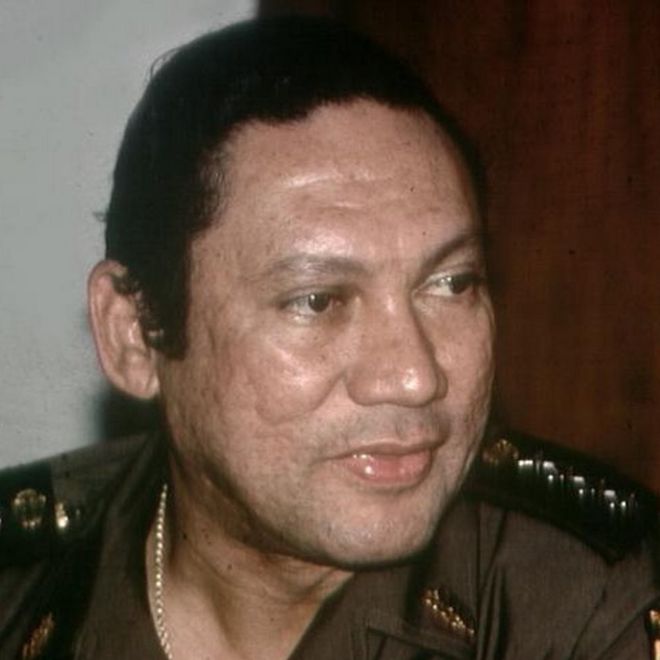
General Manuel Noriega


Manuel NoriegaImage copyrightVISNEWS
General Manuel Noriega was one of long line of Latin American military leaders who rose to take political power.
Although he was never elected to office he became the de facto leader of Panama serving a six year tenure as military governor.
A strong supporter of the United States he became a key ally in Washington's attempts to battle the influence of communism in central America.
But it was eventually the US that brought about his downfall and his subsequent imprisonment for drugs trafficking and money laundering.
Manuel Antonio Noriega Moreno was born in Panama City on 11 Feb 1934. His family lived in extreme poverty but he was adopted as a young boy and went on to study at a military academy in Peru.
It was here that, according to various accounts, his pro-US leanings were noticed by the CIA with whom he worked for the next three decades. He was soon recognised as a prize asset in a region that was becoming politically hostile to US interests in the wake of the Cuban Revolution.
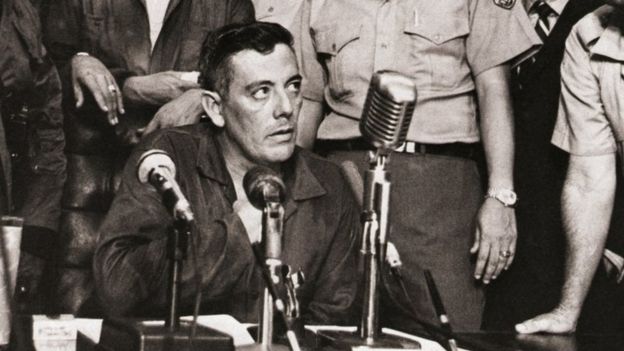
Gen Omar TorrijosImage copyrightGETTY IMAGES
Image captionGen Omar Torrijos led the military coup in which Noriega took part
He rose within the ranks of the Panamanian armed forces and became a key supporter of Gen Omar Torrijos, who led the coup which toppled President Arnulfo Arias in 1968.
Noriega's support was recognised with promotion and appointment as chief of military intelligence.
After Gen Torrijos's death in a mysterious plane crash in 1981, Noriega became the power behind the scenes as head of the security services.

Beheaded

The US relied on Panama as a regional listening post and Noriega obliged with unfaltering support for the Contras in Nicaragua, and in the fight against the FMLN guerrillas in El Salvador.
In 1983 Noriega became commander of the armed forces in succession to Rubén Darío Paredes on the understanding that Paredes would stand as president. However, Noriega reneged on the deal, arrested Paredes and promoted himself to general becoming the de facto ruler of Panama.
He began to play an increasingly repressive role internally in Panama. He called a halt to the counting of votes in the 1984 presidential elections when it became clear his own nominee was going to lose by a landslide.
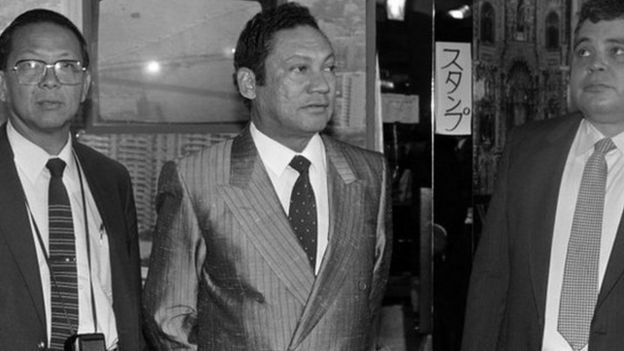
Manuel NoriegaImage copyrightGETTY IMAGES
Image captionNoriega (c) played an increasingly repressive role in Panama
A year later one of his most vocal political opponents Hugo Spadafora, was seized on his way back to Panama and later found beheaded.
Noriega allegedly played a role in the mid-1980s Iran-Contra affair, which involved the smuggling of weapons and drugs to aid US undercover efforts to support the anti-government forces opposing the Sandinistas in Nicaragua.
However, the US became increasingly suspicious of Noriega amid indications that he was selling his services to other intelligence bodies, not to mention drug-trafficking organisations.

Heavy metal

These tensions became public in 1988 when Noriega was indicted in a US federal court on drug-trafficking charges.
The 1989 presidential election descended into farce. With the opposition certain of a comfortable victory Noriega blocked publication of the results. Former US president Jimmy Carter, in the country as an observer, declared that the election had been stolen.
By mid-December that year, ties with the US had deteriorated so far that President George H W Bush launched an invasion, ostensibly because a US marine had been killed in Panama City, although the operation had been months in the planning.
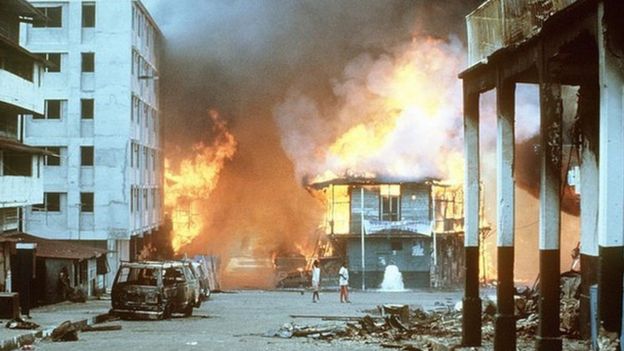
Buildings blaze during the US invasion of PanamaImage copyrightUS ARMY
Image captionBuildings on fire after US troops invaded Panama in 1989
Noriega sought refuge in the Vatican's diplomatic mission in Panama City. The US tactic to flush him out was to play deafening pop and heavy metal music non-stop outside the building.
By 3 January 1990, it had worked and Noriega surrendered. He was flown to the US with prisoner of war status to face charges of drug-trafficking, money-laundering and racketeering.
His trial there was an international spectacle that revealed titillating details of his personal life including a suggestion that he wore red underwear to ward off the "evil eye".

Money laundering

More seriously he was refused permission by the court to cite details of his work for the CIA in his own defence. The government opposed such disclosures on the grounds it was classified information.
He was released from a Miami jail in 2007 having had his original 30 year sentence reduced to 17 on the grounds of his good behaviour but his legal problems were far from over.
In 1999 a French court had convicted him in absentia of using $3m in proceeds from Colombia's Medellin drug cartel to buy property in France.
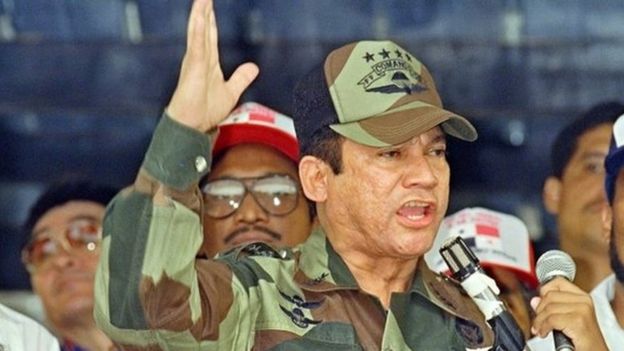
Manuel NoriegaImage copyrightGETTY IMAGES
Image captionThere were indications he was aiding drug traffickers
In March 2010, the US Supreme Court agreed to a French request extradite him to Paris, where he faced a new trial for money-laundering. Noriega, who denied the charges, was found guilty and sentenced to seven years.
The sentence was criticised by Alberto Almanza who headed the Truth Commission on rights abuses under Noriega's rule.
"He'll die in in prison," Mr Almanza said. "And with him the truth."

Lawsuit

His legal odyssey took another turn on 23 November 2011 when a French court approved a request from Panama to send him back home, where he was convicted in absentia of murder, corruption and embezzlement.
He refused the chance to appeal the decision and flew out of Paris on 11 December 2011, escorted by a team of Panamanian officials and a doctor.
On his arrival in Panama he was placed in the El Renacer prison. It was from his cell in July 2014 that he instigated a lawsuit claiming that the company behind the video game Call of Duty: Black Ops II had used his image without permission.
His main complaint was that the game depicted him as a "kidnapper, murderer, and enemy of the state".
Manuel Noriega was an opportunist who used his close relationship with the United States to boost his own power in Panama and to cover the illegal activities for which he was eventually convicted.
A US Senate sub-committee once described Washington's relationship with Noriega as one of the United States' most serious foreign policy failures.

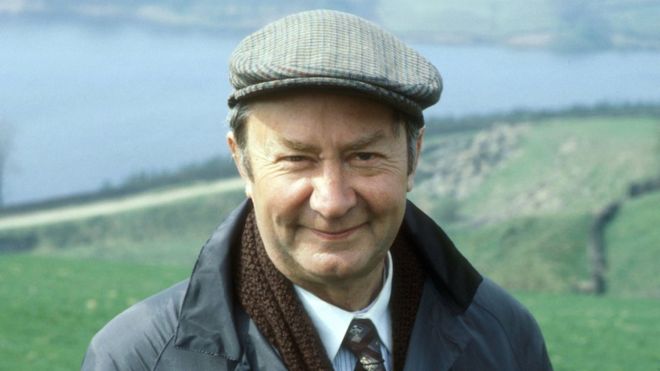
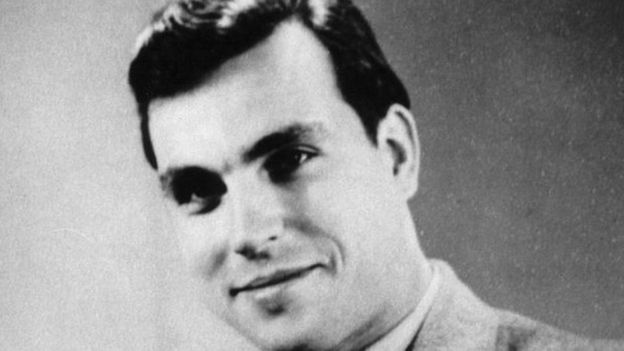
Peter Sallis


Peter Sallis
Image captionPeter Sallis became a household name in the UK in the comedy Last Of The Summer Wine
Peter Sallis was best known as the mild-mannered Norman Clegg in Last of the Summer Wine.
By the time he first appeared in the role he had already carved out a distinguished career in the theatre and on television.
His role as the flat-capped philosopher made him the longest-serving cast member of the much-loved series.
And he reached an even wider audience as the voice of Wallace, the cheese-loving character in the animated series, Wallace and Gromit.
Peter Sallis was born on 1 February 1921 in Twickenham, Middlesex.
After attending Minchenden Grammar School in Southgate, north London, where the family had moved, he emulated his father and went to work in a bank.
The acting bug first struck during his wartime service in the RAF, when he was asked to play the lead role in an amateur production of Noel Coward's play Hay Fever.
"Acting is a matter of instinct," he later said when appearing on Desert Island Discs. "As soon as I was on the stage I just felt so at home."
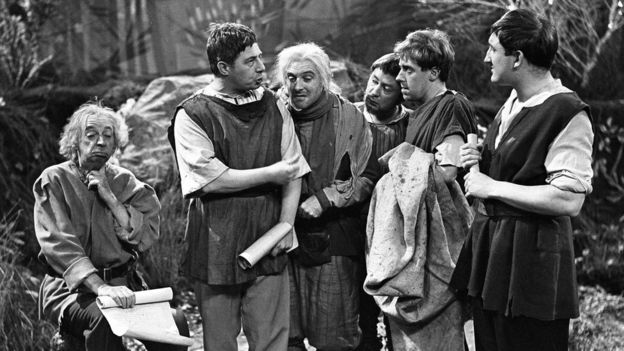
Peter Sallis (third from right) as Snug in a 1958 production of A Midsummer Night's Dream
Image captionPeter Sallis (third from right) as Snug in a 1958 production of A Midsummer Night's Dream
When hostilities ceased he enrolled at the Royal Academy of Dramatic Art (Rada).
His first professional appearance came in 1946 and for the next six decades he was rarely out of work.
Throughout the 1950s he made a name for himself as a reliable character actor playing everything from Shakespeare to Chekhov.

Arguments

His first play with a star cast was a production of Three Sisters, where he appeared alongside Ralph Richardson and Celia Johnson.
He had film roles in Anastasia, The VIPs and Wuthering Heights, but it was for his television work that he was better known.
He had already acted in two TV plays by writer Roy Clarke, in one playing a transvestite, before landing the role of Clegg in a Comedy Playhouse episode entitled Of Funerals and Fish.
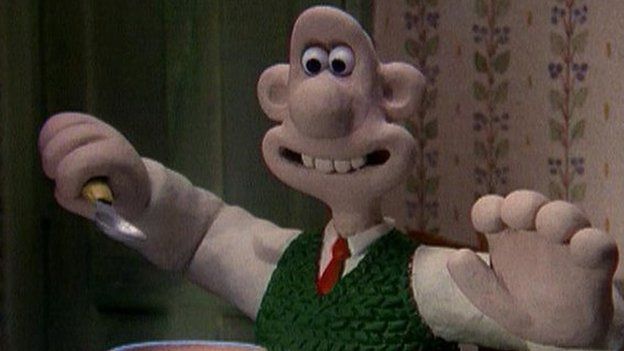
Wallace from Wallace & GromitImage copyrightAARDMAN ANIMATION
Image captionWallace was modelled on Sallis
This was successful enough for the BBC to commission a series with the revised title Last of the Summer Wine.
Surprisingly, given its later success, the first series was not well received by either audiences or critics.
Sallis recalled that filming of the early episodes was enlivened by off-screen arguments between his fellow actors Michael Bates and Bill Owen.
"Michael Bates was somewhere to the right of Margaret Thatcher," he said. "And Bill Owen was somewhere to the left of Lenin. It was all incomprehensible to me as I'd never had a political thought in my life."

Modern classics

The series sparked an appreciation society and a deluge of tourists to the Yorkshire village where it was filmed.
Sallis said, "You would not find me getting up to anything crazy that Clegg gets up to, but I have been very lucky to be a part of it all."
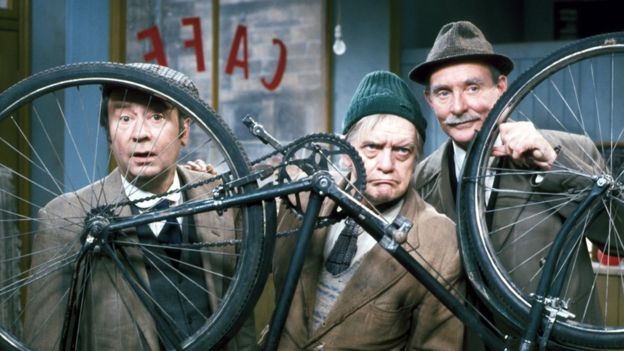
Peter Sallis, Bill Owen and Michael Bates - the original trio in Last of the Summer Wine
Image captionPeter Sallis, Bill Owen and Michael Bates - the original trio in Last of the Summer Wine
As well as Summer Wine, Sallis appeared in the Pallisers and The Diary of Samuel Pepys. In addition, he wrote a stage play, End of Term, and also a handful of radio plays.
Despite calling himself "only mildly well-known", after 30 years of playing Clegg, Sallis's face was one of the most familiar on British television.
And in 1992 his voice became recognisable across the world, when his distinctive tones graced the character of Wallace in Nick Park's celebrated animation films.
As one half of Wallace and Gromit, he appeared in such modern classics as The Wrong Trousers and A Close Shave.
Asked for the inspiration behind Wallace, Nick Park called Sallis his automatic choice and explained how the actor had even helped influence the character's face.
He said: "There was something about his voice that somehow insisted I make Wallace's mouth really wide to get it around the syllables."
Peter Sallis considered himself very fortunate to be in the hands of talented scriptwriters.
But his own gentle manner and natural timing certainly helped create comic characters of enduring and wide-ranging appeal.
It was with the mild-mannered Clegg that he felt most at home.
"I am like him in many ways. I am fairly retiring and do not like to be the centre of attention. I think I'm well cast."

Helmut Kohl


Helmut Kohl
Helmut Kohl earned his place in history by securing the successful reunification of Germany after the collapse of communism.
His 16 years in office made him the longest-serving German chancellor since Bismarck and he was once described as the greatest European leader in the second half of the 20th Century.
He was a passionate supporter of greater European integration and was one of the main architects of the Maastricht Treaty.
Yet the end of his career was marred by economic problems in the old East Germany and a financial scandal within his own CDU party.
Helmut Josef Michael Kohl was born on 3 April 1930 into a conservative, Catholic family,
His political outlook was shaped by his experiences in his hometown of Ludwigshafen in the Rhineland during World War Two.
Because of its huge chemical works, the town was heavily bombed and, at the age of 12, the young Helmut found himself helping to recover the charred bodies of his neighbours from the rubble. What he once described as "the blessing of a late birth" freed him from any taints of Nazism.
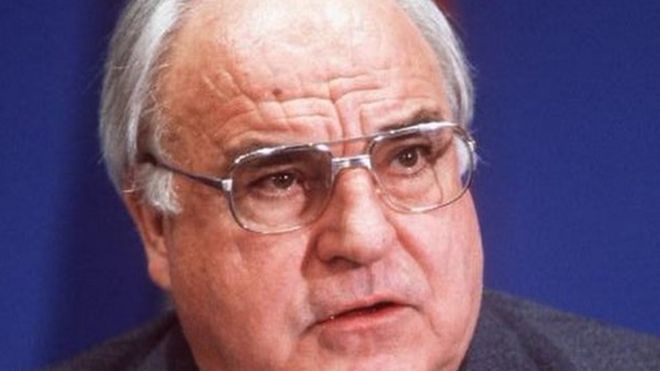
Helmut KohlImage copyrightGETTY IMAGES
Image captionHe became the youngest minister-president in 1969
After studying politics and law at Heidelberg University, Kohl entered politics in the German federal system where, in the Rhineland Palatinate, he rose to become the youngest Land [federal state] minister-president at the age of 39.
He built up a large network of political allies and forced through important changes, among them the law that outlawed denominational schools unless 80% of the parents approved.
Three years later, Kohl became national chairman of the Christian Democratic Union (CDU), the dominant post-war West German political party.
He was the CDU's candidate for chancellor in the 1976 election, but was defeated by the Social Democrat/Free Democrat coalition of Helmut Schmidt.

Golden age

Four years later, Kohl looked on as another CDU candidate, and great rival, the Bavarian Prime Minister Franz Josef Strauss, also went down to defeat by Schmidt.
A bear of a man, Kohl was often ridiculed for his love of food - one nickname being "Birne" or pear - and for his often clumsy provincial manner. Beyond this, Kohl's critics relentlessly mocked him for what they said was his lacklustre oratory and apparent lack of vision.
But many underestimated his ability to wield power, which he managed through a complex, but highly effective, network of patronage and political cronies.
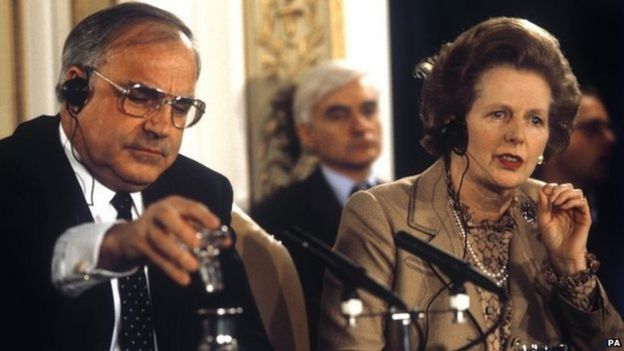
Helmut Kohl & Margaret Thatcher in 1983Image copyrightPA
Image captionHe clashed with Margaret Thatcher over greater European integration
In 1982, after the Free Democrats had left the ruling coalition, he took over as chancellor from Helmut Schmidt, and would go on to win the next four general elections, staying in power for 16 years.
The 1980s witnessed a golden age of German economic and political power. Together with his closest ally, France's President Mitterrand, Kohl shaped the federal ideal of the European Union and laid the groundwork for the creation of the single currency.
In 1987 there was a groundbreaking visit to West Germany by the East German leader, Erich Honecker. It was part of Kohl's policy of detente with the East, something his party had firmly rejected just 20 years before.
Two years later, the Berlin Wall came down and Kohl began the negotiations that would lead to reunification.

Economic dislocation

Having realised that Soviet leader Mikhail Gorbachev's attempts to reform communism would fail, Kohl persuaded him to withdraw from East Germany, while allowing a reunited Germany to remain a member of Nato.
The 350,000 Soviet troops based in the East were sent home, the costs borne by the West German government. On 3 October 1990, East Germany ceased to exist with its five historical states becoming part of the new federal republic.
Kohl's drive for reunification was not welcomed by everyone, with Israel's Prime Minister Yitzhak Shamir publicly opposing it. While broadly welcomed by the West, there were concerns, notably in Britain and Poland, that a strong unified Germany would come to dominate the continent.
But Kohl was able to convince Gorbachev and US President George HW Bush that a united Germany would not destabilise or threaten Europe in the way Hitler's Germany had done.
"George Bush was for me the most important ally on the road to German unity," he said.
Kohl also made the political decision to grant East Germans immediate economic parity, even though his central bankers told him of the massive economic dislocation this would incur. They predicted correctly that Germany's economy would be badly affected for a decade.
Even so, Helmut Kohl had pulled off a remarkable political coup that might not have occurred had he dithered. But the huge economic repercussions of reunification robbed him of some of the popularity he might have expected, particularly in the former East where, during one visit, he was pelted with eggs.
Under his rule, the East suffered an economic collapse, with high rates of poverty and unemployment the norm. And the costs of reunification led to an economic downturn throughout Germany.

Strained relationship

He was slow to respond when neo-Nazis burned down the homes of immigrant Turkish families and hostels for refugees from Africa. He sometimes pushed aside the concerns of smaller nations to the east, like the Czechs and the Poles.
And he had a strained relationship with the UK and other countries that did not share his vision of a federal Europe.
Chief among Kohl's perceived antagonists was Margaret Thatcher. In a revealing volume of autobiography, published in 2005, he alleged that her anger boiled over in December 1989 after she was obliged to sign a communique supporting German reunification.
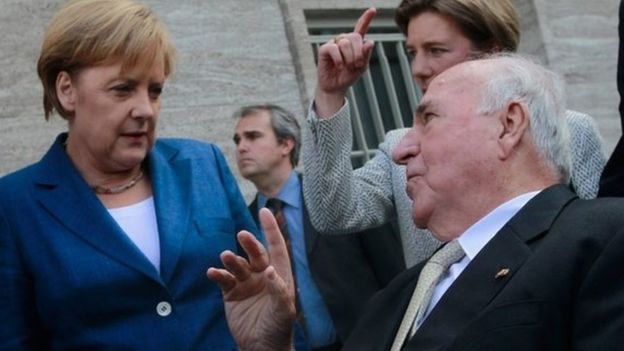
Angela Merkel & Helmut KohlImage copyrightGETTY IMAGES
Image captionHe joined Angela Merkel at the 20th anniversary of German reunification in 2010
"I will never forget Margaret Thatcher's angry observation: 'We have beaten the Germans twice. Now they're back.'"
After he lost power in elections in 1998, it was revealed that Kohl had accepted, for his party, millions of dollars of secret political donations.
Despite refusing to name the donors, and despite his destroying much potentially incriminating evidence before he left the chancellery, he was spared possible corruption charges out of respect for his years of leadership.
But his reputation was badly damaged. To his opponents, Helmut Kohl could be insensitive and a bully. The suicide of his wife, Hannelore, in July 2001, seemed to exemplify his political and personal eclipse.
In 2010, an ailing Helmut Kohl joined Chancellor Angela Merkel in celebrations to mark the 20th anniversary of German reunification, something that will be seen as his greatest achievement.
"I have been underestimated for decades," he once said. "I have done very well that way."